INTRODUCTION
Good morning, ladies and gentlemen.
On behalf of the CLRL, I thank you for responding to our invitation to this all-important gathering.
One of the core objectives of this gathering is to invite you, “the media and the general public” into a partnership for a new form of advocacy that will highlight social anomalies and push for reforms that will make the Ghanaian society better for the ordinary Ghanaian including you and I.
The Centre for Legitimacy and Rule of law is a non-political, non-governmental, civil society organisation. We are made up of forward-thinking individuals who believe in Justice and the Rule of Law. We are emboldened in our belief by the fact that nations that respect justice and rule of law have so far prospered more than those who do not. These nations have progressed in several ways because they have predictable environments, their citizens live better lives and their businesses progress and grow if they situate themselves within the limits, frameworks and opportunities of the laws of their nation.
We believe that Ghana’s 1992 constitution, being the most enduring constitution of this country with over 3 decades of survival, must be given the needed boost, by deepening justice or legitimacy and the rule of law which will ensure that Ghanaians earn our democratic dividends under the law we have appointed for ourselves to guide our society. Indeed, we the citizens of Ghana wield power to demand for reforms that will make us a better society, but power concedes nothing without a demand.
We therefore intend to commence and we are commencing today, a spirited advocacy for causes that we believe will inure to the benefit of the majority of Ghanaians and to this end, we are inviting you to be a partner with us to push worthy and noble causes that matter to the people of Ghana.
We also intend to subject state laws, justice systems and government policies to critical scrutiny, and analysis to reveal the advantages and disadvantages and without any political intentions, promote what we deem useful and criticise what we deem dangerous or not beneficial to the ordinary person in Ghana.
To this end, we hereby invite interested individuals and organisations, to join forces with us on this path so that together we can improve on our just, equitable and rule of law dividends for ourselves.
We shall need the unflinching and unalloyed support of our brothers and sisters in the ink fraternity and we ask you to stand with us in this field.
We may be contacted through the following means: Website: www.cjrlghana.org, info@cjrlghana.org
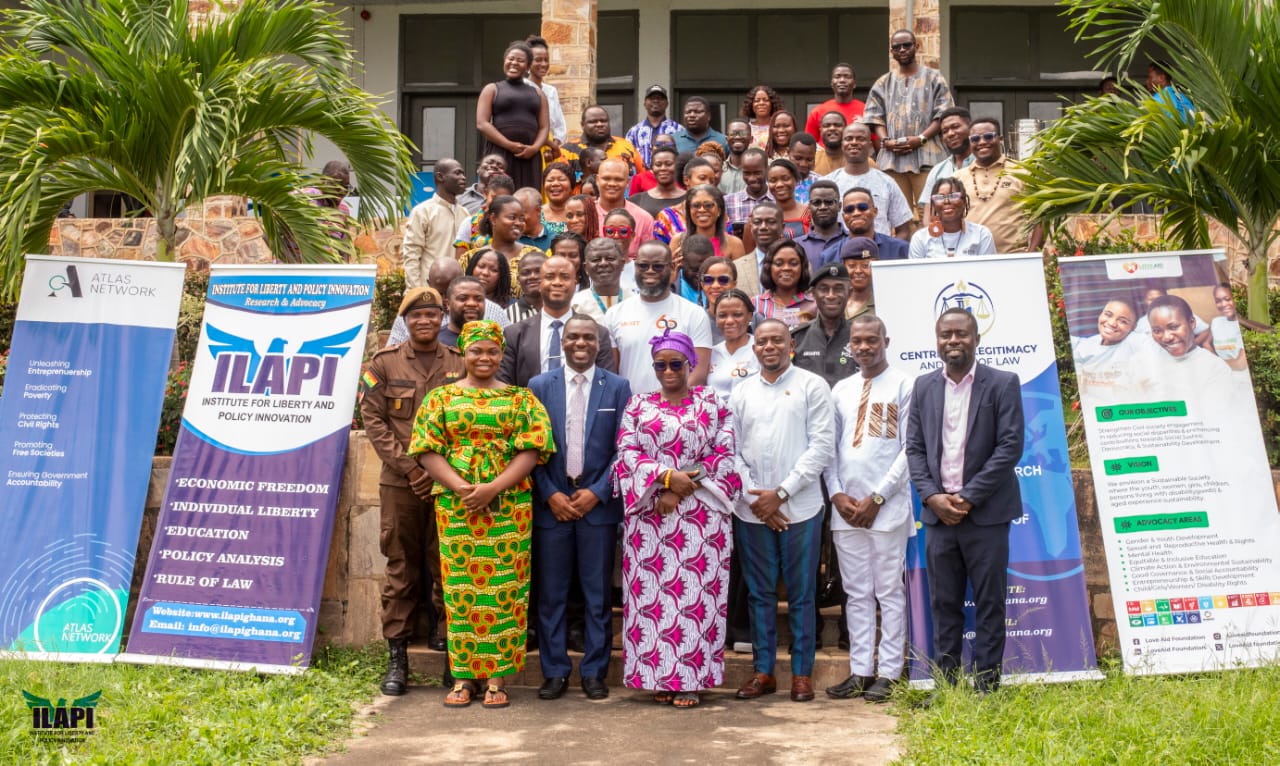
Some of our directors and members are present and I would like to take the opportunity to introduce them before I continue.
1. I am the Executive Director of CLRL and my name is Richard Nii Amarh. Let me add that I am not the Billionaire and owner of Bills Microfinance. I am just a humble social advocate who believes that I can join forces with others to make society better for all of us.
2. We also have Divine Nkrumah here. He is a very well-known personality in Ghanaian media space. He is an entrepreneur and a certified Project Management Consultant. He is a member of the Board and our Director of Projects.
3. Mr. Peter Bismark Kwofie is the Executive Director of the Institutes for Liberty and Policy Innovation (ILAPI) and he is Policy Adviser on the Board.
4. Mr. Bernand Kofi Boateng is a lawyer, a policy advocate and a critical thinker. He is also a member of our Board.
5. Nana Yaw Gyamfi is also a member of the Board, lawyer based in Koforidua and a Lecturer at the Koforidua Technical University.
It is important to state that we are not starting our work from scratch. We acknowledge the good work being done by many civil society organisations in the country, and we intend to build on and complement their work all in an effort to make our society better than before.
I will make a special mention of ILAPI, which has given us their Executive Director in the person of Mr. Peter Bismark Kwofie to sit on our board and help us shape our young group.
They have done extensive work on a project called Next of Kin which has sought to highlight the challenges that poor people face in accessing resources at the bank that they are supposed to inherit from their deceased relatives. We have taken inspiration from this project and we intend to take it to the next level and advocate for legal and policy reforms that will ensure that persons who are legitimately entitled to locked up funds in our banking system are given the funds in order to alleviate their financial situation and improve their lives.
An organization called Widow and Son for example, has also been working on helping widows and their children get their due share of deceased persons estate especially in
communities which have consistently not respected the rights of children and widows under the laws of Ghana. It's worthy of notice that despite its existence for over 4 decades, the principles and mechanisms of the Intestate Succession Law, PNDC Law 111 is yet to be fully accepted in our cultural settings whilst the Police, the Courts and the Attorney General’s Office keep pushing the responsibility of enforcing rights of victims through punishment to the doors of each other.
It is worth noting that Ghana’s legal system is one of the best in Africa and continues to improve. But we cannot be complacent when we can even do better hence our desire to push for better legal frameworks.
We hope that with your support, we can collectively highlight discussions of these matters and get the relevant state authorities to act on them for the benefit of the society at large.
Having given this background, I wish to say, that I stand here on behalf of all my colleagues at the Centre for Legitimacy and Rule of Law both present and far, to declare that on this 6th day of May 2026, we have officially opened and started work as a civil society organization with a focus on seeking and advocating for justice and promoting the rule of law for the benefit of all Ghanaians.
God Bless our homeland Ghana.
PROJECTS FOR 2026 – RELEASE THE UNCLAIMED FUNDS
Ladies and Gentlemen,
Having declared that we have formally opened, we would like to proceed to the ground immediately with a project for the year 2026. That project is called – Release the Unclaimed Funds.
As at October 2024, the Institute for Liberty and Policy Innovation (ILAPI) discovered through an RTI request that the Bank of Ghana had received for “what they call” safe keeping, unclaimed funds from banks totalling:
a. GHC 167,810, 267.68 and another
b. USD 14,654,139.51 and another
c. GBP 2,432,069.77
d. EUR 2,304,985.82
You will notice that a conversion of the Forex amounts into cedis will sum up to approximately GHC 229, 279, 693.96 and that added to the cedi amount of GHC 167 million will give a total of GHC 397,091,961.68 as at October of 2024.
It is safe to say that as at October of 2024, the Bank of Ghana held almost GHC 400,000,000 of unclaimed funds.
These are funds that were sitting in various accounts at the various banks that the owners have not come back to claim them. We do not have the figure for Mobile Money companies as at now, but it is our estimation that it could even be higher.
Why are these called Unclaimed Funds
It is the law under the Banks and Specialised Deposit-Taking Institutions Act, 2016,
Act 930
that when an account has not been operated for more than 2 years, the bank holding the account, must declare that account as dormant and if after another 3 years, the owner does not come back to re-activate the account, the bank is required to transfer the money in that account to the bank of Ghana for “safe-keeping”.
In October of 2024, the Bank of Ghana responded to an RTI request from ILAPI and gave these figures and we believe as we speak now, this figure could be far higher than that.
WHAT CAUSES ACCOUNTS TO BECOME DORMANT
1. Death of the account holder whose family is unaware of the existence of the account.
2. Prolonged sickness that affects the brain and cognitive abilities of the account owner.
3. Relocation of the account owner.
4. Litigation and a pause in business operations in the case of companies.
5. others
Amongst these identified causes, death is probably the number one.
As we speak, no one can tell when he or she will be called by the maker. Death is expected of all, but when, we cannot be sure. For security and safety reasons, we rarely disclose our account details to even our closest lovers. We all know what happened when the Biblical Sampson disclosed his secret to his beloved wife Delilah.
This notwithstanding, we would still love that in the event that we are no more, these same family and friends that we are afraid to disclose our account details to, would rather have access to the funds in it rather than for the state to “confiscate” these amounts and keep them with the Bank of Ghana without the money even earning interests.
We work so hard to earn money, we keep them either in Banks or in our Mobile Money wallets, and because we fail or forget to make adequate provisions on how that money
should be used upon our death, the money gets locked up with the Banks and the Telcos.
Now, for all the amounts we have mentioned above, it would surprise you to know that they may have relatives who are in dire need of money. Breadwinners die every day only for their families to be thrown into poverty whilst their hard-earned money sits at the banks and earns no interest as soon as it is transferred to the Bank of Ghana.
There are even situations that the account owner may be suffering from mental situations and if the family got to know about the account, they could apply to the court to give someone the power to operate the account and use the money to take care of the person in the mental facility. But these funds lie idle whilst the owner may be left out of the mental facility for lack of funds to take care of the owner.
It is our belief and projection that if these funds are released back to the families of those whose funds have gone dormant, it will reduce poverty in many homes in this country, promote investments into SMEs and solve many problems.
WHAT ARE THE BOTTLENECKS?
Methods of Administering the Estates of Deceased Persons
There are two ways of disposing off the assets of a deceased person. Either through Wills or through the PNDC Law 111. We have observed that both methods do not fully provide for the problem at hand.
Whilst a Will is likely to mention all known assets of the testator at the time of making the will, most testators still do create more assets after making wills and may fail to update their wills before death. For such a person, the family might fully execute the will and administer the estate without funds in an account that was later created which the family did not become aware of.
As for dissolution of estate under the PNDCL 111, the applicant for the Letters of Administration is the one with the responsibility to identify all assets and bring them to the notice of the court. This also means that if the family is not aware of any account number, they are not likely to be able to include such an account number even in the application for LA and this account number stands the risk of remaining with the bank and falling into dormancy and therefore ending up with the Bank of Ghana for eternity whilst the children may be going through difficult times.
Banks Rules on Confidentiality
Whilst the court is requesting the applicant to identify assets and include them in the application for LA before coming to court, Banks on the other side would usually refuse to disclose any account details of a deceased relative to his family on grounds of confidentiality. The banks usually rely on Section 146 of the Banks and Specialised
Deposit-Taking Institutions Act, 2016, Act 930 and flatly refuse to give any details of the deceased with them.
These same banks when they sight the Obituary of their customers, quickly go and freeze all withdrawals on those bank accounts upon simply seeing the obituary in town.
It is an ancient rule of banking that account details should remain confidential between the bank and its customer and the only exceptions that banks would accept is when the account holder himself has given an authority note for there to be a disclosure on the account or when there is a court order.
Because of these rules, it is very likely that a high percentage of the dormant accounts sitting in the banks and at the BOG belong to dead persons whose estate has either been administered or not, and when it was being administered, the administrators were not aware of these accounts and therefore could not have added them for the court to grant the order for the Letters of Administration.
Some have advised that we should share our MOMO pins with others so that in case we are no more, they can access our MOMO. Well, this presents a lot of dangers. We shall rather propose some other solutions that we believe will help us all.
Our Proposed Solutions
1. BOG SHOULD ENFORCE ITS DIRECTIVES ON NOTIFICATION OF NEXT OF KIN BEFORE DECLARING ACCOUNTS DORMANT
Although Section 143(4) of Act 930 provides for the publication of dormant account information shall published or advertised in at least two daily newspapers of national circulation, the Bank of Ghana’s Unclaimed Balances and Dormant Account Directive to Banks and Specialised Deposit-Taking Institutions (February 2021) provides another layer of communication, thus, paragraph 23 states that a regulated financial institution shall contact the “Next of Kin” or other designated person of the Dormant Account Holder where efforts to locate the Dormant Account Holder prove futile.
However, it is evidently clear that the banks often limit their efforts to publishing notices in newspapers. They are not actively engaging with the next of kin to initiate the necessary legal procedures for accessing the balances of their deceased family members’ accounts. As for the telcos, we do not see any efforts from them at all.
We are proposing to the BOG to direct the Banks and Telcos that when an account becomes dormant and the owner cannot be reached by their regular means of communication, they banks should be required to show proof that they have contacted the next of kin and if there is no such proof after some time, there should be punishment for the bank or Mobile Money company involved.
If they become aware of the death of the customer, they should then disclose the account balances to the next of kin so that this person can inform the appropriate persons with locus within the family to take the necessary steps to include such an account in the estate of the deceased.
This in our opinion, will not breach any confidential rule especially when they have prima facie evidence to show that the customer is dead. Disclosure of account information to a next of Kin, is not the same as payment of the amount in the account to that person. But this disclosure will help the family to decide if it is even worth the effort to administer that account in the estate of the deceased.
There are times that people have spent money to get court orders for disclosure of bank balances of their deceased family members, only to realise that the amount in the account was not even enough to cover the filing fees they paid for the motion for the court to grant the order for the disclosure.
It is our proposal that accounts should only become subject to transfer to the BOG after there is proof that the next of kin is also not reachable after reasonable efforts have been made.
Under the law, the Bank of Ghana also has the power to direct the banks to change their policies on disclosure as soon as they receive prima facie evidence that an account holder is deceased.
We are also asking that the Bank of Ghana should direct all banks to immediately start contacting Next of Kin on accounts which have already gone dormant and find out the whereabouts of the customers so that if it is established that those account holders are indeed deceased, the families can take action to recover these amounts.
There could be situations where the person might be alive but may be suffering from a sickness that affects the brain and therefore cannot tell his/her family about an account with funds, yet they may be suffering looking for funds to care for that person.
1. REQUEST FOR MORE THAN ONE NEXT OF KIN FROM ALL CUSTOMERS
Noting the importance of the next of kin, we are also asking the Bank of Ghana to direct all Banks to request for more than one next of Kin during account opening process so that in the event that one of them is not reachable when they are needed, there could be the chance that the other would be reachable.
2. BOG SHOULD CREATE A DEDICATED WEBSITE FOR DORMANT ACCOUNTS
Despite the Directives from the Bank of Ghana for the Banks to publish Dormant accounts on their website, only a few of them are actively doing it and even that few, the information they provide is inadequate. For Example, if you provide Godfred Awuku, Ring Road Branch date of dormancy 5th August 2022. There could be several of such names, at least the date of birth would help families to know if its their family member or not.
Secondly, there is no effort to make people aware of even this small information on their website.
Request of Bank of Ghana to push the banks to do more by way of advertising for people to know about this information.
Further to this, the BOG could also create or mandate to be created, a dedicated website where all dormant accounts from all banks and all Mobile Money companies could be published so that the general public can run searches on these sites from time to time to get information of accounts of their deceased family members and or those in need.
This request is not a novelty. It actually happens in other countries and I will give just one example. In Massachusetts, in the USA, the State Treasurer has a website called findmassmoney.gov. This is a public website where you can go and put in your information and it will supply you with some clues to assist you to fine money that may be yours but you may not be aware. For example, money belonging to a dead relative.
It is important to note that when these amounts are released, the government also gains because every amount inserted in either probate or a letter of administration attracts an estate duty tax of 3% of the value of the money.
After today’s press conference, we are going to petition the following institutions in an attempt to get them to act on these concerns and we shall update you along the way for any progress we are able to achieve from any of them.
1. The Bank of Ghana.
a. All Banks
b. All Mobile Money Operators
2. Parliament of Ghana
3. Attorney General and Minister of Justice Thank you for making time for us today.